A Strong Desire to Dream
How are we supposed to read when it's too hot to think?

How are we supposed to read when it’s too hot to think? Hiding from the light, guilt-tripping my host into turning on the evil-yet-desirable air-conditioning, I pull a book off the shelf and my eyes fall upon these words:
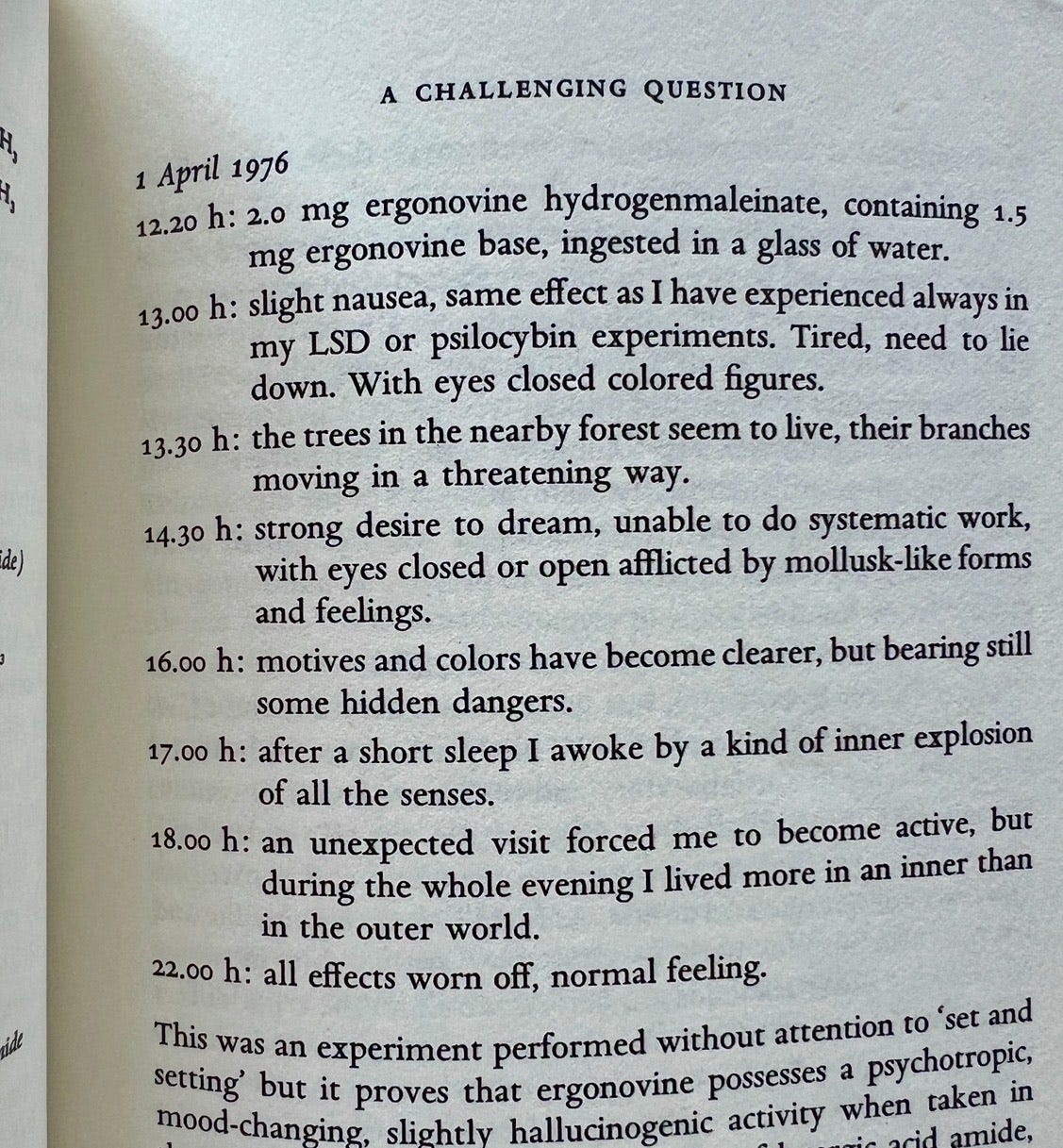
“Strong desire to dream, unable to do systematic work, with eyes closed or open afflicted by mollusk-like forms and feelings”
Q: Where does this phrase come from? A: While my band Matmos was on tour in Greece I had the pleasure of visiting the home of the musician and artist Jay Glass Dubs aka Dimitris Papadatos and his wife, the harpist and composer, Sissi Makropolou aka Sissi Rada (people in our line of work often have two names). In the middle of a discussion of the ancient Pythia and the cults of the Eleusinian mysteries, they showed me their copy of The Road to Eleusis, a collaborative book by R. Gordon Wasson, Carl A.P. Ruck, and Albert Hoffmann (the discoverer of LSD, here speculating that the ancient Pythia’s oracles may have indicated the entranced side effects of entheogens).
Roasting hot and browsing at random, I came across Albert Hoffmann’s transcription of a psychedelic experience brought on by the chemical ergonovine from April 1st, 1976. At 2:30 in the afternoon, Hoffman notes the words which I will now repeat:
“Strong desire to dream, unable to do systematic work, with eyes closed or open afflicted by mollusk-like forms and feelings”
and I thought: yes, exactly. That is the stupefying effect of this intense European heatwave that we have been following while on tour, the same punishing heat that drives us to leave our own home city of Baltimore more or less every July and August because it is simply too hot to think, the same punishing heat which now huddles and stretches across Europe, sizzling the citizens of Paris and Prague equally with an oppressive, furnace-like force. I may not be a Pythian sibyl or a Swiss chemical researcher, but I have always had “a strong desire to dream”, to doze and nap my way through the worst of it. At least in the summertime, I find myself prone to shelter in place along the reverie-stupefaction-inertia-coma spectrum, as the heat seems to slow the tempo of thought and the withering glare of the sun prompts this human mollusk to seek retreat into his psychic shell. Summer is always hot, but this summer feels especially cranked and unfeasible- but climate change condemns us to repeat these vexed and impotent pronouncements ad nauseam. Records are smashed every year. Hotter than ever, forever. Faced with such a projection, one wants, above all, to retreat into an imagined, cooler “before”, or fantasize about a winter to come. How can the world continue to be this hot? What is to be done?
Somehow, a passing sentence in a friend’s book became a springboard to a personal recognition of a feeling of stuckness in a general problem: a warming world whose affective keynote ought to be the fiery prompt to action but becomes, alas, in my own case the slow-cooked induction of something more like what Sianne Ngai terms “stuplimity”, a portmanteau conjunction of sublimity and stupidity. “Mollusk-like feelings” might mean a feeling of dehumanization-from-within, a broiling humanity losing its bearings as it devolves into something older. To live in the present warming world is to feel overwhelmed by a planetary scaled problem that prompts the ugly and politically suspect reflex of escapism, the urge to flee, to arrive at a somewhere beyond or away. But there is no escape. Turning inward towards our dreaming-mollusk-reveries, we stay haunted by the disabling force of the heat itself: we are left “unable to do systematic work.”
*record scratch* Hence, a Substack? This violent segue might sound like an unpromising start as far as preambles to personal Substacks go, but bear with me: my point is that I tend to feel my way through life by noticing tiny things in books, cropping and collecting them, and then connecting them to everyday experience, thinking about them some more, and perhaps building broader claims out from those captured fragments, admittedly in a loose, essayistic, and free-associative manner. Since X/Twitter is a fascist sewer that I cling to mostly out of stubbornness and (let’s be real) the ability to self-promote my band and professional academic activities, and I don’t want to spend much time on Facebook as it is the site of too much data-scraping and surveillance, and I am too longwinded to force such thoughts into breadcrumb trail “threads” for X or BlueSky forever, I finally arrive here.
I am starting an occasional Substack not in hopes of glory or financial windfall but as a way to preserve such fleeting moments of noticing the everyday, the literary, the esoteric, and the odd. I hope to use this place, with all its problems, as a way share my textual and first-hand findings and my thoughts about them, ideally with people who can tolerate my tendency to “consider too curiously” upon the things that I stumble upon. Which is to say that this Substack will function a bit like an early modern person’s “commonplace book”, with me citing passages that seem thought-provoking, well-formed, shiny, captivating, eerie, or simply that merit re-circulation in my opinion. You should expect that every week or so I will write a post, often in dialogue with what I have been reading or thinking about, and that it will be written in a mixed mode that blends personal essays and reflections, critical assertions, direct quotation and ruminating, navel-gazing and angry ranting interspersed with odd spasms of joyous yelling and enthusiasm about miscellaneous ephemera. Thanks for reading.
Matmos:
Link to the Wasson/Ruck/Hoffmann text: https://archive.org/details/roadtoeleusisunv0000wass
Jay Glass Dubs:
https://jayglassdubs.bandcamp.com/
Sissi Rada:
End Climate Silence:
https://www.endclimatesilence.org/
Welcome to Substack! I suspect you’ll like it better than Facebook, because the algorithm seems not to be designed specifically for outrage.