Reciprocal Clouds
On Aging, Re-Reading, and the Atmospheric Illusion of a Self

One of the distinct pleasures of growing older is re-reading. Taking up a book one has already read can feel, in the right circumstance, like meeting a long-lost acquaintance, a way to both measure and close the distance that separates who we are and who we once were. Such an encounter turns the re-read book into a kind of estuary in which the fresh water of the present and the salty ocean of the past splash and mix as this sense of “the changing same” both ratifies and refreshes. One is poised for the pleasure of tasting an almost forgotten vintage, but there is also an undercurrent of fear at the possibility of deflationary disappointment. What if the book we once thought was great only seemed so because we hadn’t yet formed criteria? What if we cannot return to the past person we were when we first read that book? What if our present attempts to return only disfigure the past? These questions weren’t really on my mind when, somewhat at random in an English-language Prague bookstore in the midst of a terrible heatwave, I decided impulsively to buy and re-read Kierkegaard’s “The Sickness Unto Death.” It wasn’t entirely random-- I had taught “Fear and Trembling” the semester before-- but close enough. Since I was, and am. in the middle of a two month musical tour of the world, I didn’t have space in my backpack for another big fat novel, so the slender disquisition of Kierkegaard writing in disguise as Anti-Climacus about despair and its remedy would have to do.
I think I sought to return to the book in part because I had felt that my first reading was somehow inadequate and clumsy; instead of striding majestically through the scenic garden of his arguments, my first reading in hindsight had felt more like fumbling in the dark for the light switch to an unfamiliar hotel bathroom (I’m on tour). Perhaps I re-read it because I felt I had something to prove, or, more egotistically, perhaps I now felt that I was, at last, actually ready to read and understand. Now I know where the light switch is, and now I know what is the trashcan and what is the sink. And so I re-read the book, underlining key claims, nodding at piquant phrases, alternately charmed by the psychological insight and repelled by the blanket theological commitments that underwrote its sweeping dismissals of pagan and, really, all non-Christian- perspectives. Never mind that such dismissals were themselves followed by a sense that almost the entirely of actually extant Christianity too was simply an example of unseriousness, nigh unto blasphemy, a refusal to really encounter the central paradoxical core of faith as such, which for Anti-Climacus trembles before us in the examples of Abraham and Christ but seems entirely absent from the everyday world of merely dutiful conformist church attendance. So far, so Kierkegaardian. What I wasn’t really ready for was a central passage on the difference between youth and maturity.
Since I’m going to worry at and consider too curiously this passage I had better quote it in full here:
“There are essentially two forms of illusion: that of hope and that of recollection. The adolescent’s illusion is that of hope, that of the adult recollection. But precisely because the adult suffers from this illusion, his conception of illusion is also the quite one-sided one that the only illusion is the illusion of hope. And that is understandable. What afflicts the adult is not so much the illusion of hope as, no doubt among other things, the grotesque illusion of looking down from some supposedly higher vantage-point, free from illusion, upon the illusions of the young. The young person is illuded: he hopes for the extraordinary both from life and from himself. While as far as adult illusion is concerned, on the other hand, this is often found in the adult’s recollection of youth. . . . This fuimus [we have been], which we so often hear from older people, is just as great an illusion as the younger person’s illusions of the future; they lie or invent, both of them.”
-Søren Kierkegaard, The Sickness Unto Death, Trans Alastair Hannay, Penguin, 1989, page 89.
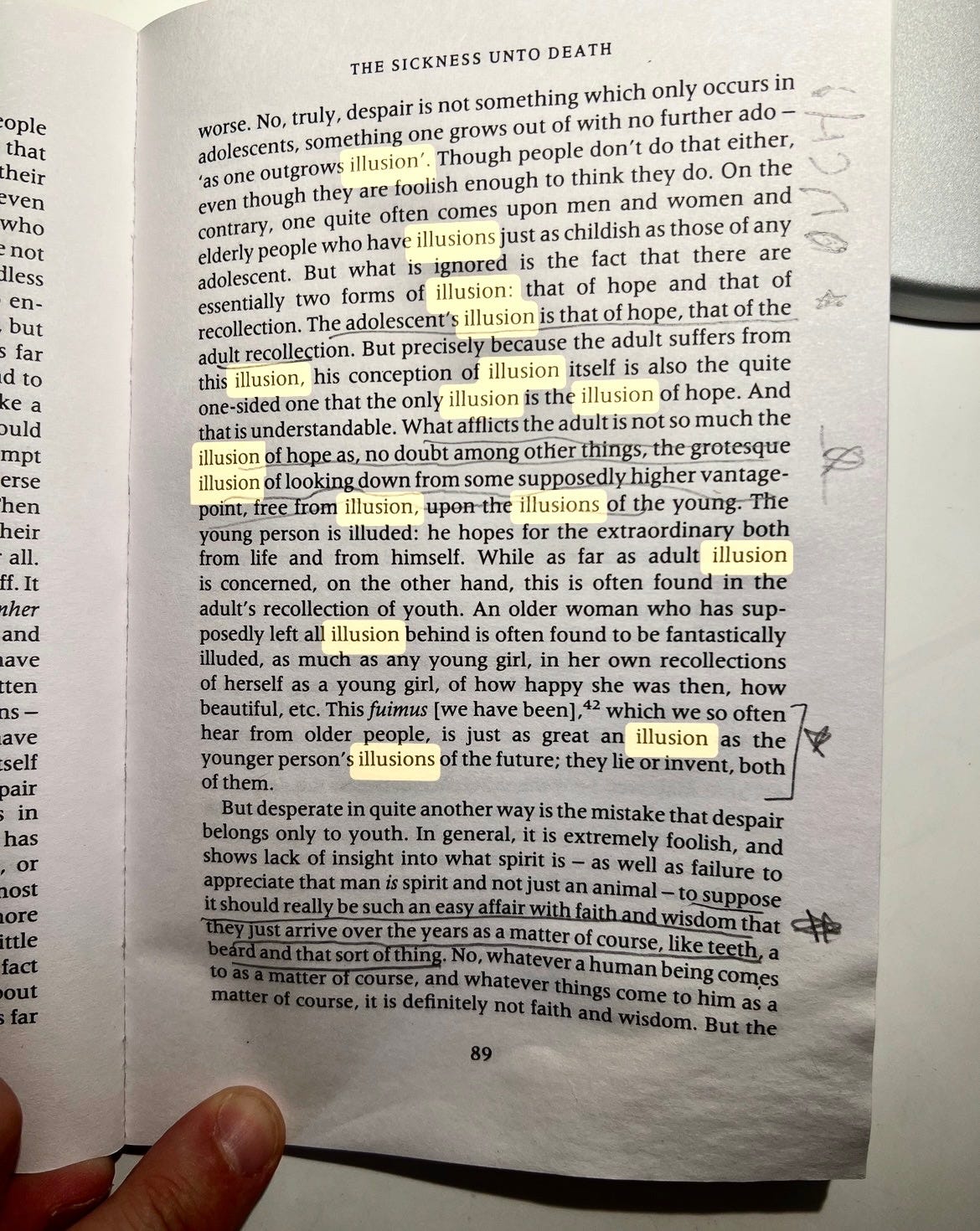
I might as well also point out that while I re-read this passage- literally as the words on the page made their way into and through me- I was on an airplane flying from Athens to Geneva, looking out the cabin window from “a higher vantage point”, surveying a stunning alpine vista of snowy peaks piercing the cloud layer. That is, just as I read about the “grotesque illusion” of smug falsity with which an adult imagines that their advanced age entitles them to look down upon others, or backwards across their life, with a sense of mastery and elevation, there, before me, was this precise perspectival temptation. Look at the beauty of what lies below you! Now you can comprehend and see beneath you both the philosophical peak of Kierkegaard’s text and the very illustrative mountain itself that embodies its ideas in rocky, cloud-shattering form! Kierkegaard’s forbidding argument, meet Switzerland’s fanged crags.
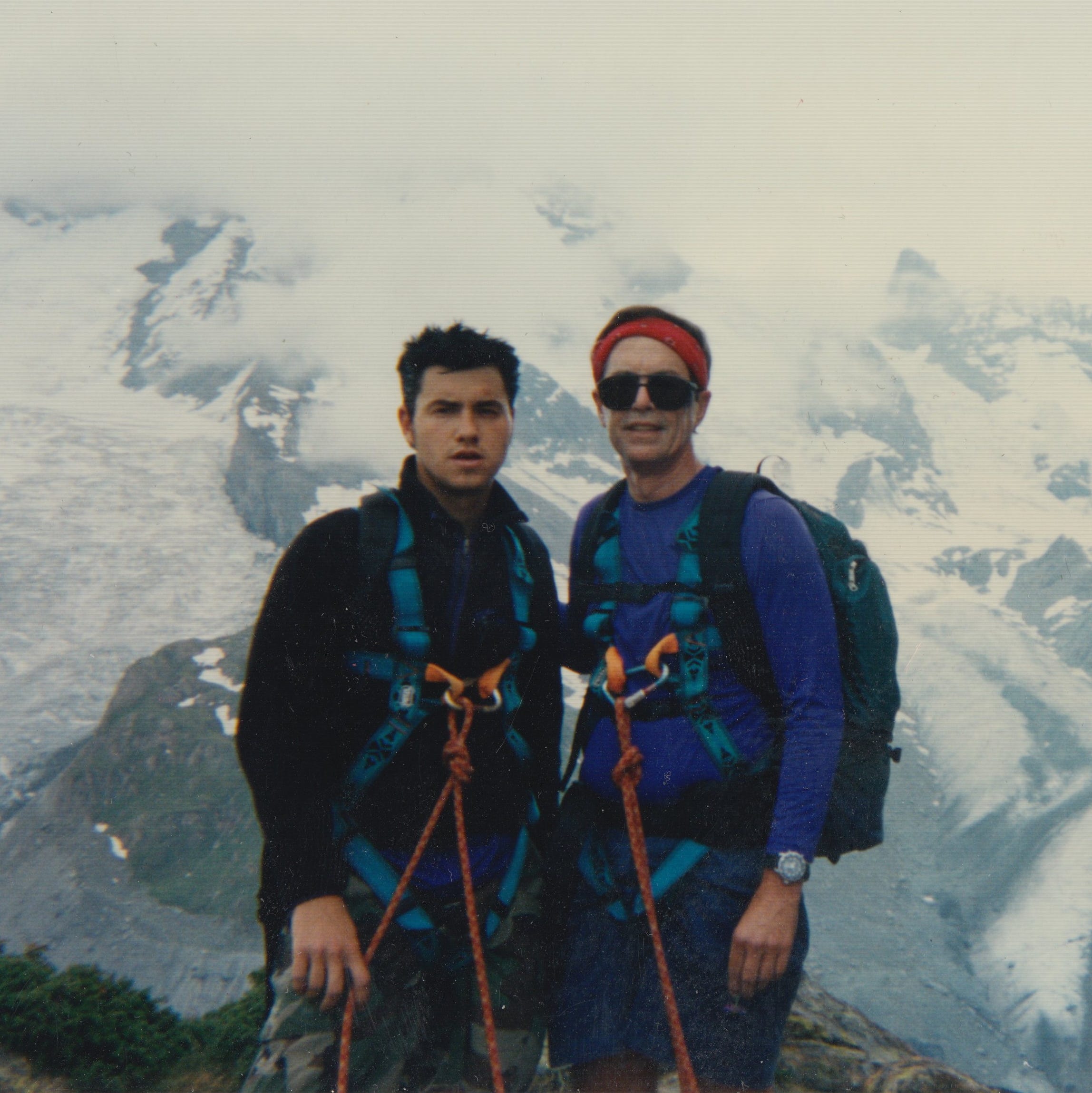
As it happens, when I was a much younger man I did, in fact, climb an alpine mountain. Specifically, I climbed the Matterhorn with my father, a father/son adventure shot through with- at least for me-- intense Oedipal affective charges and barely submerged competitive conflict between us, part of a complex lifelong bond-which-is-also-a-distance. We climbed it together, but had very different experiences, in part because we did so at different moments in our own lives and development. Hovering thousands of feet above the air, the mountain image seemed to temptingly offer up the illusion that not only had I climbed a mountain and was therefore somehow in possession of its meaning or its secret but now I was higher still, in a position to literally look down upon it, comprehending it fully as I now falsely believed I could traverse a philosophical text without sinking into crevasses of confusion and error.
It would be wrong to say that returning to Kierkegaard offered me a better perspective. Rather, Kierkegaard’s text seems to spritz a kind of skeptical acid onto the very project of imagining that life is development, that we progress in a linear manner from ignorance to knowledge, that the mature person has acquired a cumulative wisdom which they are now in a position to either pompously lord over others or generously extol to them. The Kierkegaard passage that I read on the plane challenges both the young and the old, both the son and the father, refusing to afford to either position any freedom from the charge of pervasive, rampant illusion, of lies and inventions that falsify our account of who we are through forward-looking hopes that project onto who we might someday become or backward-looking nostalgia as we fabricate who we take ourselves to have once been.
I don’t know if I can manage to wrestle into compliance the complexity of how this experience of re-reading resonated for me as I gazed from the clouds out the window to the philosophical text in my lap, the same text that had long ago eluded me, and then down at a mountain range that included at least one mountain that I had successfully climbed, long ago in my youth with its no doubt illusory hopes of extraordinary futures. That I was able to climb that mountain at all only happened because of the help of experienced mountain guides, harnesses, ropelines, and the central fact of my father’s original desire to climb this mountain, generous desire to include me on that journey, and material ability to fund the travel and assistance required to do it and live to tell (cue the memory of our trip to the graveyard of those unfortunate climbers who had died on the mountain to propitiate their unhappy ghosts before our own summit day). A web of dynamic contingencies encircle the ascent: the weather was fine, I was strong, I never slipped, a rope never frayed, a piton never pulled out from the cliff face, no one twisted an ankle, etc. I climbed the Matterhorn but I did not master it. I am not sure how to calibrate the position from which I speak. Isn’t the disavowal of mastery another one of mastery’s poses, even, in the Socratic tradition, its most beloved pose? Don’t people love to pooh-pooh things as they brag about having done them?
I am writing this in advance of my 55th birthday as a way of marking time rather than as a way of making peace in the struggle between younger and older versions of the self, between different forms of ascent and descent, between fathers and sons, between first readings and second readings. It would be dishonest to say that I do not think that I am, now, a better reader of Kierkegaard than I was before. Upon my first reading, I think my mind rather balked at the idea of “a negative unity” and of “a relation that relates to its own self-relation” rather than to either of its constituent parts. Decades after my first puzzling encounter, having now read Hegel’s “Phenomenology of Spirit” I am somewhat more comfortable with such dialectical finger-puzzles and formal maneuvers. But that comfort might itself be one of the illusions that are so dear to older people: the illusion of cumulative progress, the sense that our minds are richly stocked cellars of experience whose contents we can pour forth at will.
Though this might be a trick of the mind, I honestly do feel that I have a better relationship with my father now: we talk every Sunday afternoon, more or less (when I’m not on tour), and there’s far less fear and misprision in those exchanges than in the past. But is my sense of progress an illusion? My father has a favorite rug with a distinctive pattern called “reciprocal clouds,” a poetic name for a Chinese pattern, found in many rugs produced along the Silk Road, in which delicate blue and white patterns of positive and negative space interlock. It is dear to him: he had a special bedframe built to support the bed from its center so that the front bedposts would float above the delicate pile of the carefully executed, mathematical structure in which a thin but sharp border allows these distinct shapes to touch and tesselate. When I think of that rug, so carefully stage-managed and secured into place, it seems to propose to me a kind of allegory of our own bond-across-a-distance. Are we not, in fact “reciprocal clouds” to each other, present, but present as changing forms, holding a certain shape and then just as relentlessly, shifting and changing shape again?
I think about why this image stands out to me, and then in a moment of re-reading it flashes before me: the center of the image itself lay in the very same Kierkegaard text I have just re-read, precisely in the moment when Kierkegaard, harrowing the project of subjectivity as such, describes in a flash of illumination a threshold at which “the individual himself has finally become nothing but an atmospheric illusion.” Perhaps the pull of the image of “reciprocal clouds” as a model of myself to my father, and my father to myself, emerges not from the carpet upon the floor but from the way that a philosophical text, half understood, itself somewhat cloudy, helped me look again at that carpet, and think about its possible meaning, holding the memory. Reading and re-reading across a distance over the years as we change our forms and perspectives, are we not, all of us, such “reciprocal clouds” to each other?
It is here that I ought to turn on the bullshit detector and just admit that this very habit of fondling metaphors and staring in a blinkered manner at passing, exemplary images within philosophical texts is precisely not how philosophy asks to be read and understood. To read in this way is to snag upon the exposed sharp points and protrusions, the flinty edges of the mountain. The point is to climb and experience the whole. But that’s the problem: such mastery might itself be an illusion, a false picture that we use to protect ourselves from the overwhelming relentless too-much-ness of the mountain of life as we traverse its surfaces on our journey from first readings to re-readings, from the illusions dear to young people to the illusions dear to older people. I know how to read a book: one sentence at a time. I know how to climb a mountain: one step at a time. I have arrived at something: in a day or two I will be age 55. But in trying to know others or myself, how far can I really go? What is it that I think I really know?
Happy almost-birthday, Drew (the 17th if I remember correctly?) Lovely essay. So glad to hear you’re in a good place with your dad. I remember when you climbed the Matterhorn. At the time, I couldn’t fathom why someone would want to do that, but it seems even more impressive now through the lens of our ages.
When I first saw this, I thought it was a page from Tom Phillips’ A Humument! And by coincidence, I had just ordered a repress of Irma from Superior Viaduct…