Scorpion Mind
On Byron, Mental Freedom, and Suicide

Content warning: this essay discusses self-harm / suicide.
We had complicated plans. Traveling from Switzerland to Italy across an itinerary that would take us through scenic mountain passes and alpine lakes, our day’s journey called for no less than four trains: Vevey to Genève, Genève to Luzern, Luzern to Lugano, Lugano to Parma. It was all about tight connections, both from train to train and at the end of the day, when our last train was to arrive at 7:30 pm and we would hustle to a hotel check out desk that closed at 8:00 pm. Tight but manageable. There we sat in the morning sunlight of our first train, tantalizingly close to Genève when, in the station of Gland (pronounced “glon”) we heard the voice on the speakers announce that the train would no longer proceed as planned. Translating distorted French as I watched a worried group of Swiss Rail conductors in a huddle outside our carriage, I heard a nervous sounding voice say that there had been an accident at the station in Nyon, and that our train was about to go backwards to Lausanne.
It was only later, checking the Swiss Rail Instagram account and seeing comments about “this individual’s tragic decision” that the penny dropped: someone had died by suicide, presumably throwing themselves in front of the train at the station directly ahead of us. The computerized logistics at the Lausanne train office kicked in, instantly re-routing us to a new itinerary that was, in fact, optimized for efficiency: Lausanne to Zürich, and then boarding in Zürich the very train that would wind its way seamlessly across the same alpine scenery and into Parma. If you look closely at an anthill you will invariably see the tiny dotted lines of minuscule figures marching on their distinct paths, barely stopping to consider the smashed form of one of their dead comrades. Our rail journey took on the macabre functionality of such an anthill rondelay. What is the death of a total stranger, now? What meaning could it have for any of us as we pressed inexorably forwards?
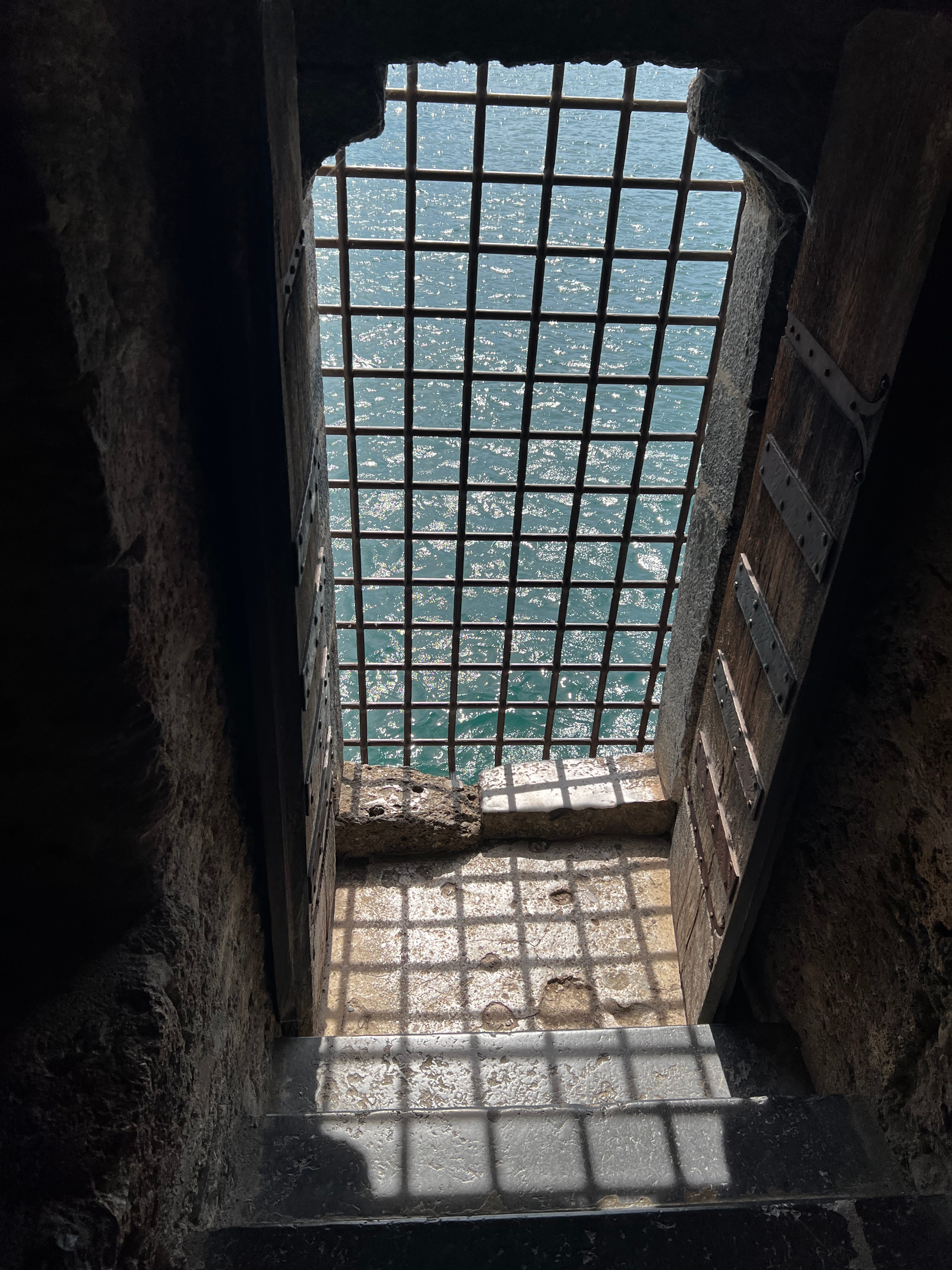
As it happened, that day on the train I was reading Byron’s poetry. I had selected this book on a whim because, while in Switzerland, we had visited the Chateau de Chillon one day after lunch in Montreux and had gawked at the chains and pillars displayed in its lakeside dungeons, the much celebrated site of Byron’s much celebrated poem “The Prisoner of Chillon” and its associated sonnet on mental freedom in the midst of bondage. The poem’s memorable celebration of the mind at ease in the midst of constraint runs thus:
Eternal spirit of the chainless Mind!
Brightest in dungeons, Liberty! Thou art,
For there thy habitation is the heart-
The heart which love of thee alone can bind
And when thy sons to fetters are consign’d-
To fetters, and the damp vault’s dayless gloom,
Their country conquers with their martyrdom,
And Freedom’s fame finds wings on every wind.
Lord Byron, “Sonnet on Chillon”, 1816
These words, reproduced on a plastic board on display inside the prison, not far from the advertisements for the Chateau’s wineries, announce an alluring promise: to have a mind is to have the possibility of inner freedom, to have the ability to escape and transcend circumstances. This is a consolatory theme that those familiar with the literature of the enslaved and the incarcerated will no doubt recognize. It’s no mystery why the poem was popular. Rooted in the vindication of a Protestant martyr (Francois Bonnivard, a 16th century refugee from Calvin’s Geneva), however passionately sincere, it arrived for an English reading public (already titillated with Byron’s celebrity) precision tooled to appeal to adherents of the Church of England. Bonnivard’s unhappy condition was rooted in a form of oppression convenient to the implied English Protestant reader, but it flatters us all into imagining that, no matter how bad things get, our mind will always function on our behalf, and might even offer us some kind of trap door out of the worst of human circumstances. Happy thought, indeed.
But Byron’s poetry also speaks to the opposite condition, and precisely and painfully to the situation that re-routed our train journey that day: the mind not as the happy instrument of our liberation but as the source and site of our most painfully inescapable torment. In his equally popular but mostly, to me, rather ludicrously over-the-top fantastical poetic narrative “The Giaour”, traipsing across the Orientalist celebrations of camel’s tinkling bells and curving daggers, one comes across a singularly disturbing image: a scorpion surrounded by flames, provoked to the point of turning its stinger upon itself. It is a description of suicidal ideation. Here is the passage:
The Mind, that broods o’er guilty woes,
Is like the Scorpion girt by fire
In circle narrowing as it glows
The flames around their captive close,
Till inly search’d by thousand throes,
And maddening in her ire,
One sad and sole relief she knows,
The sting she nourished for her foes,
Whose venom never yet was vain,
Gives but one pang, and cures all pain,
And darts into her desperate brain.
So writhes the mind Remorse hath riven,
Unfit for earth, undoom’d for heaven,
Darkness above, despair beneath,
Around it flame, within it death!
(Lord Byron, “The Giaour”, lines 422-438, 1813)
I suspect that Macbeth’s vexed outburst to Lady Macbeth that “Oh, full of scorpions is my mind, dear wife” (3.2.36) might be an underlying Shakespearean source for this fanciful image of a scorpion somehow representing passion in extremis, but it may also derive from some curious nugget of false yet proverbial premodern natural philosophy about suicidal behavior in animals. Biologists queried on the matter have been quick to point out that scorpions are in fact immune to their own venom and would not die in such a manner. Regardless of its source or its factual basis, Byron subjects the image to a gruesomely extensive concentration. Reading these lines, we seem to feel agony in closeup. This image of the flame-encircled mind selecting suicide resonated for me as I contemplated the broken line of our journey. Faced with the thought of incarceration and oppression from outside, Byron imagined the mind as precisely the locus of a dangerous interior capacity for self-liberation through death, a self-damnation which is also a means of last resort to escape an unbearable psychic dilemma of a mind attacking itself.
Just how powerful is the mind, anyway? As an educator, as a human being, as someone who suffers himself from the force of intrusive thoughts, this question matters to me on both intellectual and personal grounds. There is a throughline to the revived Hegelianisms of the present (the real is the rational, the rational is the real) that would align humanity and freedom with the exercise of the capacity for reason itself. That is a best case scenario for what the mind can make possible: the absolute idea. But Byron also saw the mind through a darker glass as a maze of error and pain: the scorpion mind that stings itself, the absolutely inescapable source of a compulsion towards annihilation. The mind can kill you. Reading Byron thinking about the scorpion mind became, for me, hurtling southward on my re-organized path to Parma, a way of reaching across the indeterminate gap that separated me from the person I do not know whose actions had temporarily altered my own itinerary.
Without any clear way of speculating, I wondered about this person with whom I was connected by a thin but genuine causal chain, their act ricocheting onto my own trajectory and changing it. Who were they? What inner forces of compulsion, fear or sadness had driven them to their lonely act? Full disclosure: As the author of a book about suicide, I am familiar with the contemporary nostrums of suicidology as a field, and understand that voluntary death in the real world is a matter that lies at the intersection of many rival disciplinary registers: sociology, history, psychiatry, and the law. The demographic evidence of contemporary suicidology, commencing with Durkheim, has taught us to pan out from tree to forest: the more socially integrated someone is, the less likely they are to die from suicide. For women, according to Durkheim, the more children they have, the less likely they are to take their own lives. This is an insight that contemporary feminism might well flip around into the “family abolitionist” obverse argument- what is the enforced matrix of heterosexual reproduction but a way to ensure an eternally oncall caregiver for others who cannot take her own life because that life is already pledged to and defined by powerful webs of labor-intensive obligation? (See Sophie Lewis’ “Abolish the Family A Manifesto for Care and Liberation” for more on this). The profile of those who die from suicide in my country tilts towards solitary males with firearms in the home; as Thomas Joiner and others have pointed out, having the means to enact lethal self-harm tends unsurprisingly but tragically to increase the likelihood of a fatal outcome. Your mind will make you want to die, but if you don’t have the means to follow its commands, you might just make it to the next day, because ideation alone won’t kill you. According to sociological data, we are, all of us, held to life by the bonds with others in which we stand enmeshed. Economic evidence suggests that a raise in the minimum wage reduces the suicide rate; provide UBI (universal basic income) and the suicide rate drops further. Policy changes and personal choices meet here at the tense edge of singular decisions.
But as a portable technology for telescoping into subjectivity, poetry matters too, offering the condensation of lonely passion into a formulation of action that can let us- or at least seems to let us- zoom into the encrypted, suffering self at the heart of what is always, in its moment, a solitary and individual act of choice. I won’t presume to speak for the nameless- to me- person on the other end of the line that day in Switzerland. I cannot know if Byron’s poetic evocation of the scorpion mind captures what they were feeling or utterly misses their pointed predicament and irreversible response.
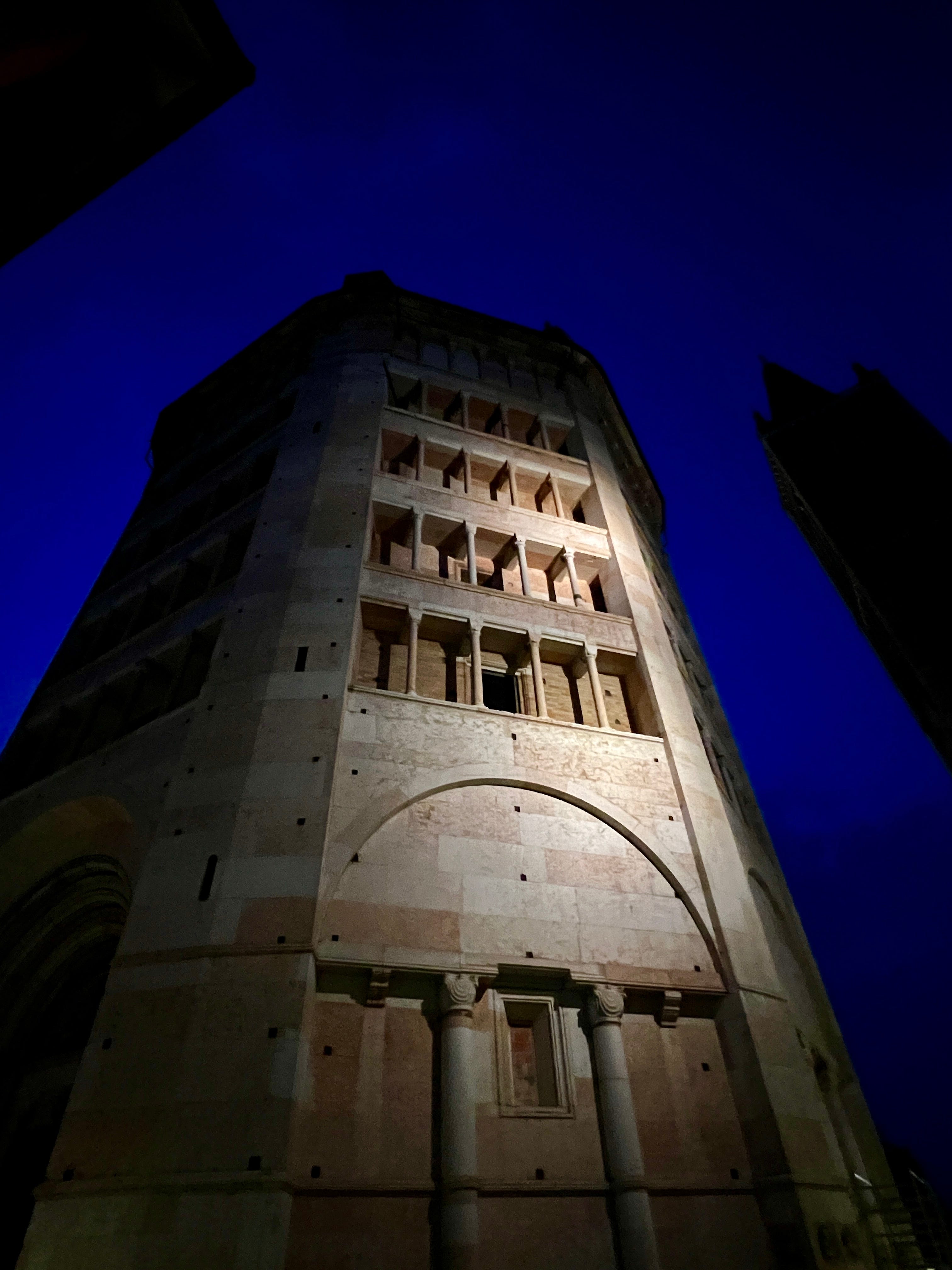
Eventually, the train comes into the station. Arriving at the end of the day at the refurbished palazzo in Parma where we could drop our bags and relax, my eyes came to rest on the justifiable tourist magnet that was our destination in the first place: the Baptistery of Parma, a late medieval masterpiece of pink Verona marble decorated with sculptures by the workshop of Benedetto Antelami and his workshop in the twelfth century, just fading from view as the sunbaked Cathedral piazza gradually phase-shifted into a moonless blue-black. A wheel of Zodiac carvings aligned with the labours of each month lines its entrance, the starry parade of astrological emblems juxtaposed with closer, lower human scenes of labor and care: a boy removing a thorn from his foot is just within reach by the threshold. Anxiously, I searched the pink stone surface in the dying sunlight for the carved inscription of one Zodiac sign in particular, a sign that the Byron poem had rendered emblematic of this oddly turbulent day. Eventually, just at the edge of my vision, carved six centuries ago, in the oak leaves above the month of October, I spotted it: serenely holding its unshakeable position within the gathering darkness, the mute form of a scorpion.
Great stuff and welcome aboard. Looking forward to more … Scorpions of the mind flourish where cultural norms have ghosted. Shakespeare’s gift was not so much that he could peer so deeply into the mind’s abyss (an infinite of that) but as poet-playwright put it into the eyes of a tragic character. Big difference between the literal scorpion bite and a literate description of it. Virtual media has destroyed much of the boundary between them.
Beautiful post.